
The FCC has adopted new closed captioning requirements to make caption settings easier to use.
By August 17, 2026, all covered devices and multichannel video programming distributors (MVPDs) must ensure captioning options meet a specific legal standard the FCC calls readily accessible—defined by four concrete factors. This means viewers should be able to quickly find, preview, and keep captions consistent across platforms without complex steps.
The FCC confirmed the compliance date on February 21, 2025, publishing the announcement at 90 FR 10041 after the Office of Management and Budget (OMB) approved the associated information collection requirements on January 10, 2025 (OMB Control No. 3060-1162).
These rules are detailed in the FCC’s Third Report and Order (FCC 24-79) and the Media Bureau’s compliance notice. In this guide, we explain who must comply, what “readily accessible” means in practice, and how to prepare for the 2026 deadline.
Key FCC Captioning Rules
The FCC closed captioning requirements go beyond simply offering captions. Entities must ensure users can easily access and adjust them. To meet the FCC’s “readily accessible” standard, companies must satisfy the following factors under 47 CFR Sec. 79.103(e)(1):
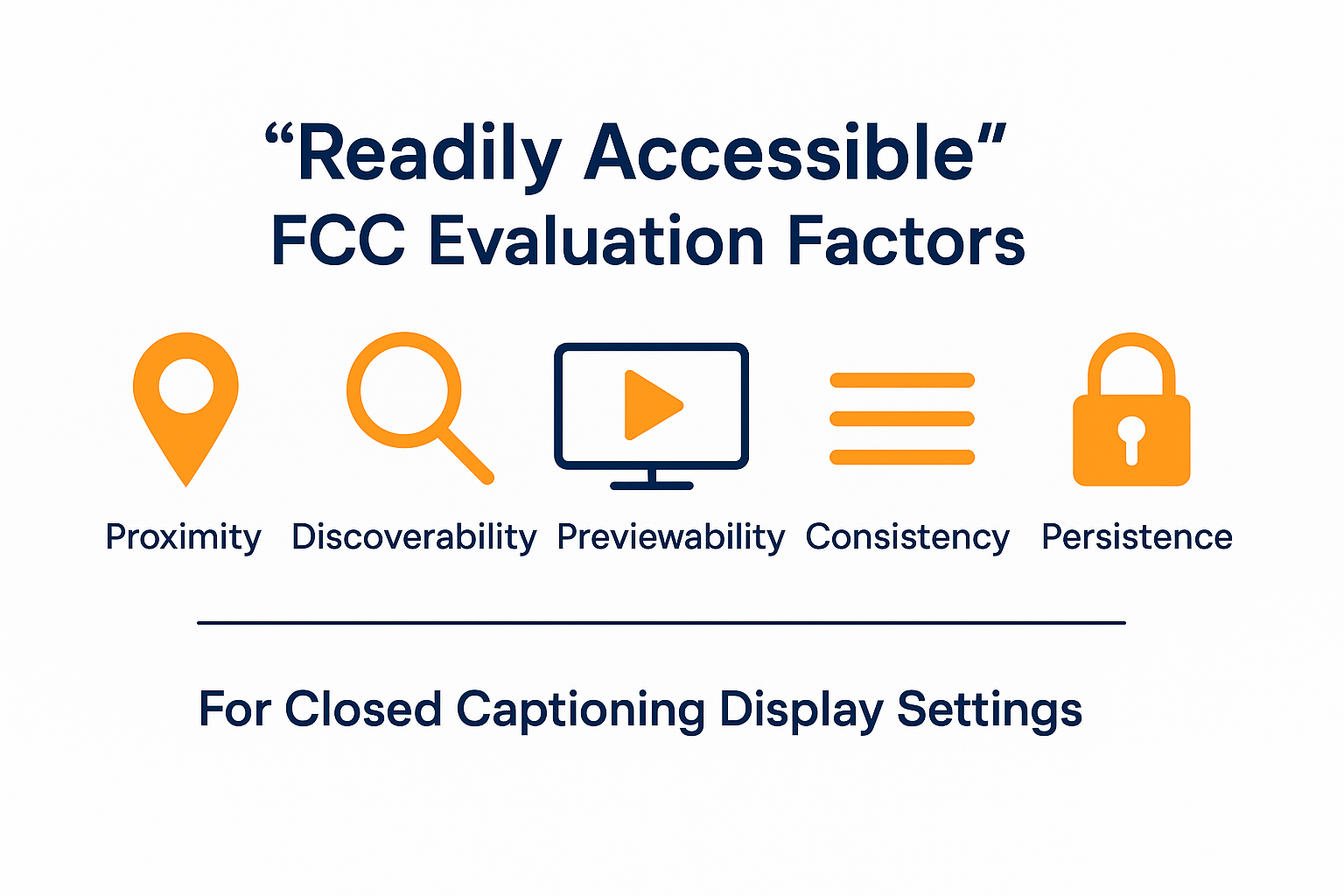
- Proximity – Caption settings must be grouped in one clear area, accessible through a button, key, or icon.
- Discoverability – Caption settings must be easy to find. Under 47 CFR Sec. 79.103(e)(1)(ii), this requires three specific actions:
- Conduct usability testing with consumers and disability groups to verify settings can be easily found;
- Make good-faith efforts to correct any problems identified during testing; and
- Train customer-facing employees on how to assist customers with caption display settings.
- Previewability – Viewers must be able to see captions change (size, color, font) while watching programming.
- Consistency and Persistence – Caption preferences must carry across apps and devices. For example, if a viewer sets their preferred font size on a cable provider’s set-top box, those settings should apply automatically when they open a streaming app on the same device—without having to configure them again. Under 47 CFR §79.103(e)(1)(iv), this involves three distinct obligations:
- MVPD navigation devices: MVPDs must expose caption settings via an API so that OTT apps can apply device-level preferences on launch. MVPDs must also notify app developers about the API.
- MVPD’s own app on third-party devices: When an MVPD’s video app runs on a smart TV or streaming stick, it must read and apply the device’s OS-level caption settings on launch.
- Device manufacturers: Apparatus manufacturers must make caption settings available to apps via an API or similar method.
These factors form the FCC’s definition of readily accessible closed captioning settings.
Who Must Comply?
The new FCC captioning regulations apply to:
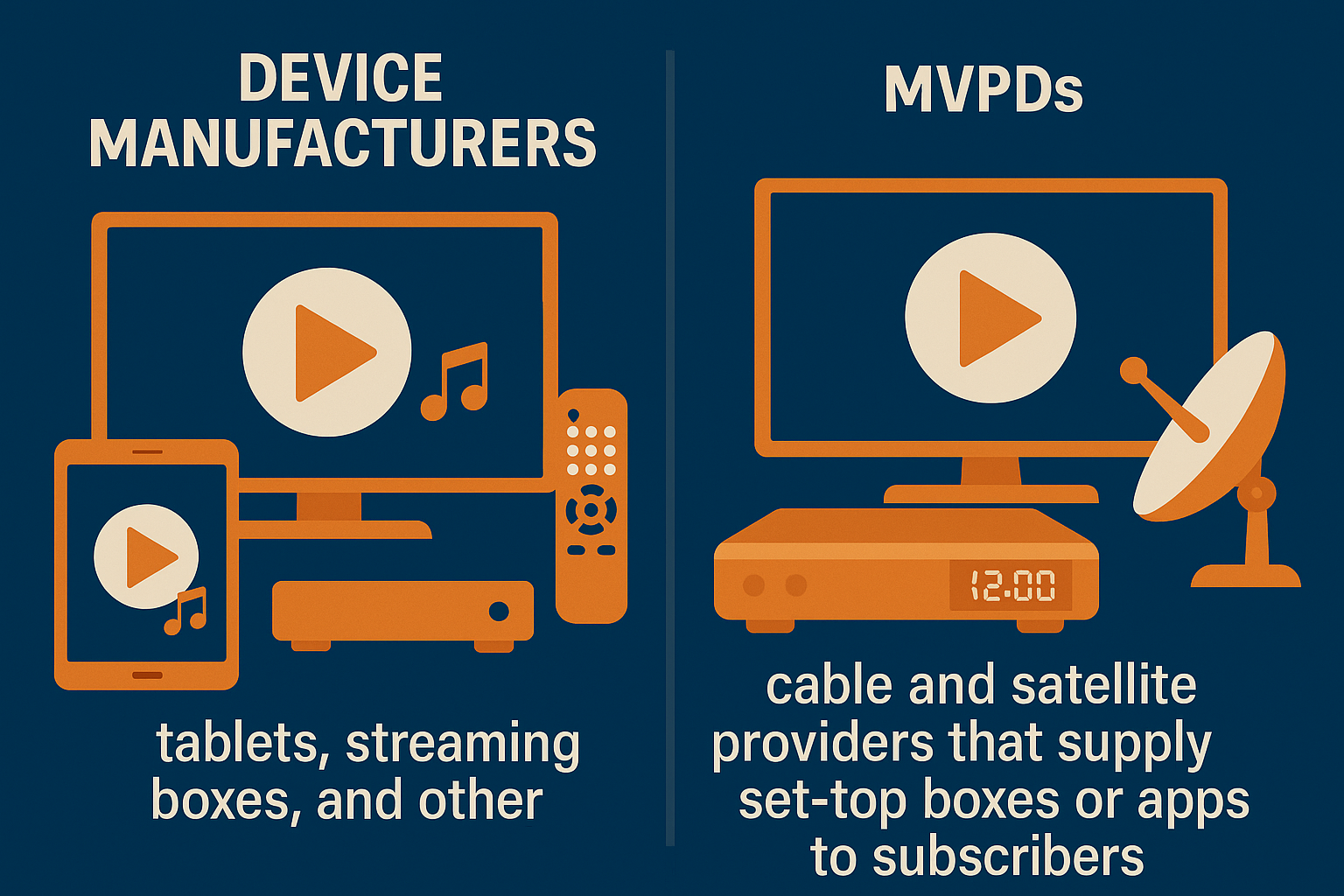
- Device Manufacturers – TVs, tablets, streaming boxes, and other devices that play video with sound.
- Multichannel Video Programming Distributors (MVPDs) – cable, satellite, and streaming TV providers that supply set-top boxes or apps to subscribers.
Both groups must meet the rules and will share responsibility for compliance under the Television Decoder Circuitry Act of 1990 and the Communications and Video Accessibility Act (CVAA) of 2010.
For a breakdown of what the CVAA requires, see our CVAA Compliance Checklist.
Compliance Timeline: Key Regulatory Dates
Understanding the difference between when the rule took effect and when compliance is required helps entities plan accordingly.
- July 18, 2024 — FCC adopted FCC 24-79, the Third Report and Order.
- September 16, 2024 — 47 CFR Sec. 79.103(e) became effective upon publication at 89 FR 66268.
- January 10, 2025 — OMB approved the information collection requirements (OMB Control No. 3060-1162, expires January 31, 2028).
- February 21, 2025 — FCC announced the official compliance date at 90 FR 10041.
- August 17, 2026 — Compliance deadline for all covered, newly manufactured devices and MVPDs.
FCC Closed Captioning Exemptions
The FCC allows limited exemptions from the closed captioning rules:
- Third-party pre-installed apps are excluded.
- Devices with screens under 13 inches only need to comply if doing so is “achievable.”
- Equipment where compliance isn’t technically feasible may qualify for an exemption.
- Devices manufactured before August 17, 2026 are not required to be retrofitted, and the rule places no restrictions on importing, shipping, or selling such apparatus (47 CFR §79.103(e)(3)).
- The rule specifically applies to devices using operating systems deployed after August 17, 2026. Devices running earlier OS versions are not subject to the new requirement (47 CFR §79.103(e)(2)).
FCC Closed Captioning Certification and Complaints
Beyond the technical requirements, compliance also involves documentation and customer support obligations. Entities must:
- Keep documentation to show they meet FCC closed captioning guidelines.
- Train customer-facing staff to help users locate and adjust caption settings.
- Provide contact information for complaints.
FCC Closed Captioning Best Practices
To stay ahead of the rules and avoid disputes, companies should adopt these best practices:
- Don’t rely on voice-only controls—many deaf users cannot access them.
- Implement the required APIs early so caption settings persist consistently across apps and devices.
- Notify application developers about your caption settings API—this is an explicit requirement for MVPD navigation device providers.
- Begin usability testing with consumers and disability groups now, well before the 2026 deadline.
- Include captioning in product design from the start—“accessibility by design.”
For an overview written for general audiences, see the FCC Consumer Guide to Closed Captioning.
Compliance Deadline: How To Prepare
August 17, 2026 is the compliance deadline for the new FCC closed captioning requirements, as confirmed in the Federal Register on February 21, 2025.
By this date:
- All covered devices and MVPDs must provide caption settings that are readily accessible, as defined by the four factors in 47 CFR §79.103(e).
- MVPDs must provide compliant equipment to deaf and hard-of-hearing customers on request.
- Apparatus manufactured before August 17, 2026 are not required to be retrofitted — the rule applies to newly manufactured devices going forward.
Note on legacy operating systems: The rule applies to devices running operating systems deployed after August 17, 2026. Devices shipped before the deadline on older OS versions are not required to be updated retroactively. If your organization is planning an OS update or a new device line to launch after that date, build compliance in from the start—retrofitting later is significantly more costly than designing for it upfront.
Quick Compliance Checklist (for 2026)
✔ Place caption settings in one easy-to-access location (Proximity)
✔ Conduct usability testing with consumers and disability groups (Discoverability)
✔ Make good-faith corrections to issues found in testing (Discoverability)
✔ Train customer-facing staff on how to assist customers with caption settings (Discoverability)
✔ Allow real-time preview of captions while adjusting settings (Previewability)
✔ Expose caption settings via API for OTT apps on MVPD navigation devices; notify app developers (Consistency & Persistence)
✔ Use OS-level caption settings in your MVPD app when launched on third-party devices (Consistency & Persistence)
✔ Make caption settings available to apps via API or similar method (Consistency & Persistence — Manufacturers)
✔ Maintain compliance documentation and provide clear complaint contacts
✔ Document that devices manufactured before August 17, 2026 are exempt from the new rule
What’s Next?
TestPros has provided accessibility services for closed captioning and video compliance for years. We’ve helped organizations design, test, and maintain captioning systems that meet FCC standards, and we can do the same for you.
Have a conversation with one of our experts—we’ll guide you through the FCC rules and make compliance easy.