
The DOJ’s April 20, 2026 Interim Final Rule extending ADA Title II digital accessibility compliance deadlines contains two separate findings about artificial intelligence. The first finding, that AI cannot reliably automate accessibility remediation at scale, received some attention. The second received almost none.
The second finding is the one that affects your communications team.
What the DOJ Found About AI-Generated Content
While the remediation finding speaks to IT directors and compliance officers evaluating automated tools, the content generation finding speaks to anyone in a government entity who uses AI to produce public-facing material. That is a much larger group than most compliance programs currently account for.
The Interim Final Rule states directly that covered entities have been generating substantial amounts of content that would be covered by the 2024 final rule using generative AI that is potentially inaccessible. The DOJ listed this as one of three specific reasons covered entities face elevated litigation risk under the rule, placing it alongside other compliance concerns serious enough to factor into the decision to extend the deadlines entirely.
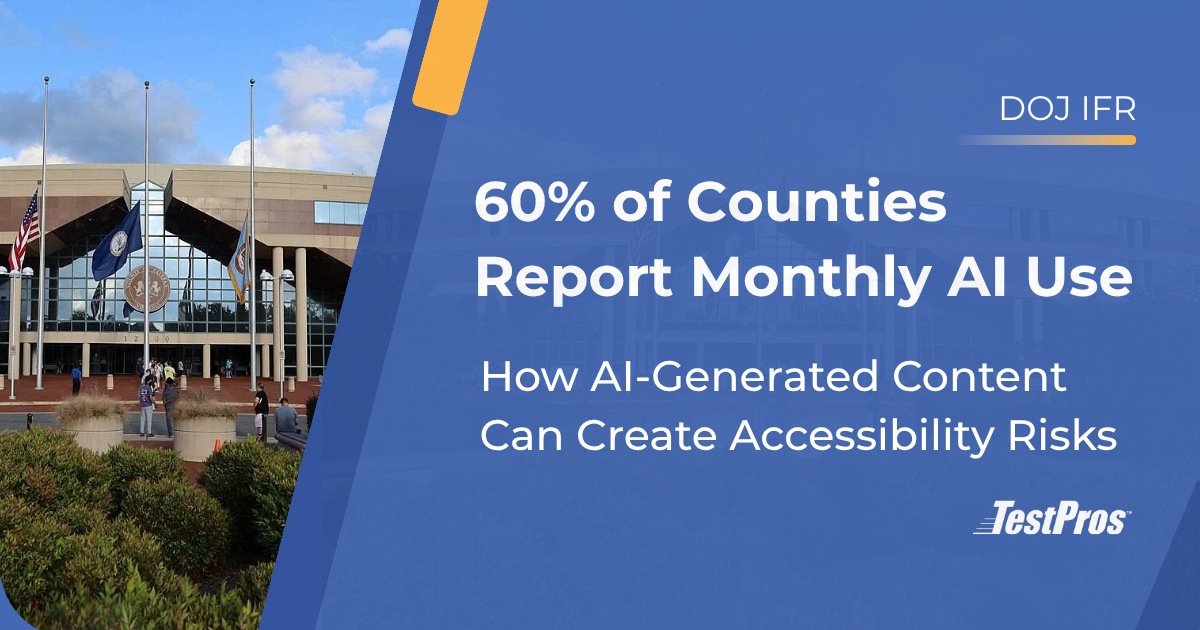
A 2024 National Association of Counties survey cited in the IFR found that 60% of counties use generative AI at least monthly. That means AI is already being used for the kinds of public-facing content accessibility programs must account for, including communications, reports, images, and policy documents.
What Inaccessible AI-Generated Content Actually Looks Like
The risk is built into the default behavior of the tools most government staff are already using.
“State-of-the-art image generation models do not output alternative (alt) text with their images, rendering them largely inaccessible to screen reader users.” — Northeastern University research cited in 91 FR 20907
That finding applies to every AI-generated image published on a government website, embedded in a government document, or shared through a government social media account without a manually added image description.

The pattern extends well beyond images:
- AI writing tools produce documents without proper heading structure, reading order, or semantic markup
- AI-generated PDFs and reports are frequently untagged and unreadable by screen readers
- AI-drafted social media content rarely includes image descriptions or accessible formatting
- AI-produced slide decks and presentations lack the structural accessibility that assistive technologies depend on
None of these failures are visible to the person publishing the content. The output looks complete on screen. The accessibility gap is invisible without testing, which is precisely why it accumulates undetected.
The Compliance Clock Is Running on Content Published Today
The DOJ extended the compliance deadline. It did not retroactively make inaccessible content compliant.
Every piece of AI-generated content published between now and the new deadline is part of the compliance record that covered entities will be measured against. Large entities have until April 26, 2027; smaller entities and special districts have until April 26, 2028. Private litigants are not bound by the DOJ’s enforcement timeline. The Title II of the ADA private right of action exists independent of when the compliance clock runs out, and inaccessible content published today can be the basis for a complaint filed tomorrow.
An entity that uses AI tools to generate content daily without an accessibility review step is not just behind on remediation. It is actively adding to the remediation backlog with every publication.
What Covered Entities Should Do
The solution is not to stop using AI content tools. The DOJ does not call for that, and the productivity value of these tools is real. The gap is the absence of an accessibility review step before publication, a step that most government content workflows do not currently include.
At minimum, covered entities should establish a review process that catches the most common AI-generated accessibility failures: missing alt text on images, unstructured documents, untagged PDFs, and inaccessible social media content. That review does not require a full audit for every piece of content, but it does require someone with accessibility knowledge in the publication workflow.
For entities that have been publishing AI-generated content for months or years, an independent digital accessibility assessment is the right starting point. It establishes what has been published, what is inaccessible, and what the remediation priority should be before that backlog becomes a liability.
The extra year the DOJ granted is time to build a workflow that stops the accumulation. TestPros works with state and local government entities to assess existing content for compliance exposure and identify where AI-generated content is creating accessibility gaps.
The W3C offers a practical starting point for content teams with its tips for writing accessible web content, but for entities with substantial published content, an independent assessment is the right first step.
If your organization is ready to get ahead of this, we are ready to help. Contact TestPros to schedule an accessibility assessment.