
Table of Contents
According to the WebAIM Million 2026 report, 95.9% of the top one million home pages had detectable WCAG 2 failures, up from 94.8% in 2025 and reversing six straight years of small improvements. WebAIM ties the backslide partly to rising page complexity and AI-assisted “vibe coding,” which is generating more inaccessible markup, not less. That failure rate translates into legal risk and real barriers for millions of users with disabilities.
Digital accessibility litigation is climbing again. Plaintiffs filed more than 5,000 digital accessibility lawsuits in 2025 across federal and state courts, including 3,117 in federal court, a 27% increase over 2024. E-commerce drew about 70% of those cases, and roughly 46% of federal cases targeted companies that had already been sued. This guide profiles leading U.S. accessibility testing and audit companies to help you choose the right partner.
Many providers lean heavily on automated tools and proprietary platforms. Automated scanning is useful and fast at catching common issues, but it detects only a subset of barriers, and WebAIM itself cautions that the absence of detected errors does not mean a page is accessible. Significant portions of conformance require manual testing and expert judgment.
Achieving true accessibility requires more than automated scans and surface-level fixes. Organizations need partners who understand assistive technologies and the real-world challenges faced by users with disabilities. The most effective approach combines automated tools for fast, broad scanning with expert manual testing for depth, so both obvious and subtle barriers are caught.
How to Evaluate an Accessibility Partner
Selecting the right partner depends on your specific needs, but these criteria are a useful starting point for evaluating any accessibility testing or audit company.
Testing capabilities
- Combined automated, manual, and user testing
- Multi-platform support (web, mobile, software)
- Proficiency with assistive technologies
- Standards expertise (WCAG, ADA, Section 508)
Team and experience
- Human testers, including people with disabilities
- Industry track record
- Certifications (IAAP, DHS Trusted Tester)
- Project portfolio
Service delivery
- Actionable reporting and analytics
- Remediation and guidance
- Client team training
- Scalable solutions
Business considerations
- Pricing structure
- Integration with dev systems
- Support and maintenance
- Service level agreements
Top U.S. Accessibility Testing and Audit Companies
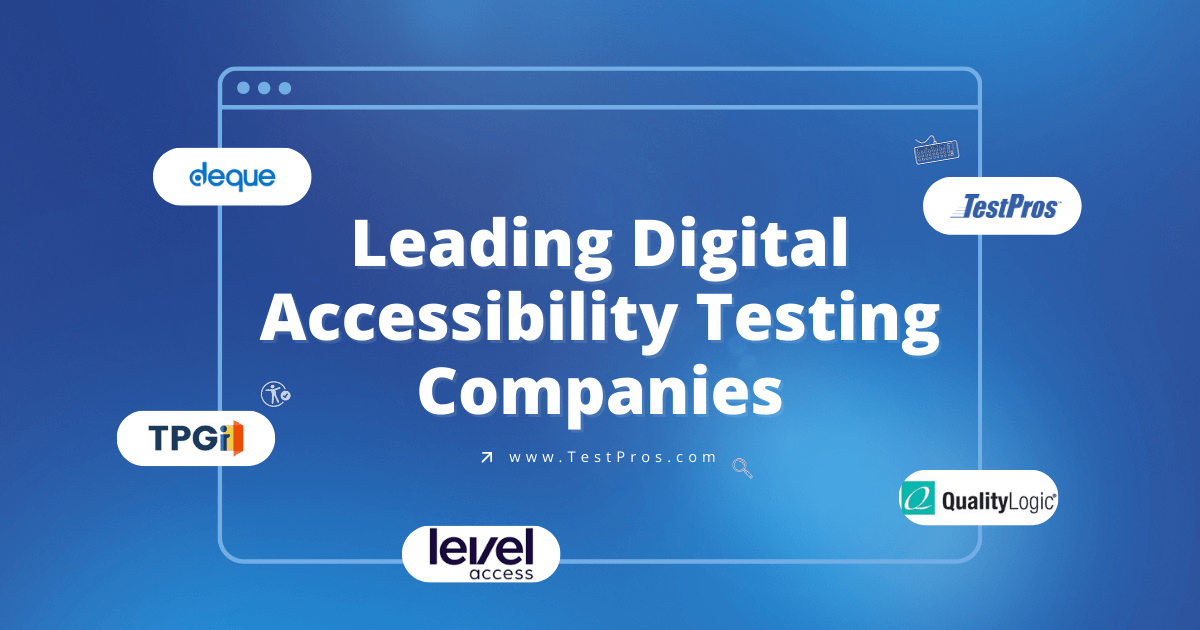
Deque Systems
Founded 1999 · Best for organizations of all sizes
A pioneer in digital accessibility, Deque Systems is known for its axe suite of testing tools and its contributions to WCAG standards development through W3C working groups. Its team holds a large number of IAAP certifications and has completed thousands of compliance projects. Through Deque University and a “shift left” approach, Deque helps organizations build accessibility into development early. Its open-source accessibility library and testing extensions are among the most widely adopted in the industry.
Level Access
Founded 1997 (as SSB BART Group) · Best for large enterprises
Level Access offers a unified accessibility platform that combines proprietary testing tools with expert manual evaluation. Its Access Engine integrates multiple frameworks, including axe-core and WAVE, alongside monitoring and analytics, and its Academy provides role-specific training. Services extend beyond the web to mobile, gaming, and embedded systems, making Level Access a fit for large enterprises with complex, multi-platform accessibility needs.
QualityLogic
Founded 1986 · Best for cost-conscious teams
Based in Boise, Idaho, QualityLogic brings decades of software testing experience to digital accessibility. Its blended methodology pairs automated tools with testing by individuals who have physical or cognitive disabilities, producing authentic usability feedback. Rather than pushing a proprietary tool, QualityLogic emphasizes real-world testing with standard assistive technologies such as JAWS, NVDA, and VoiceOver, which, combined with cost-effective pricing, suits organizations seeking practical validation from actual users.
TestPros
Founded 1988 · Best for government & contractors · Independent, tool-agnostic
Established in 1988, TestPros focuses on government and government-contractor accessibility testing, with clients including DHS, HHS, GSA, and many federal contractors. Its manual testing follows the DHS Trusted Tester protocol and IAAP standards, and it selects the automated tools that best fit each product, commercial or open-source, rather than relying on a single toolset. Because TestPros sells no scanner, overlay, or other accessibility product, its tool choices and findings reflect what the assessment needs, not what it has to sell. Services include manual testing with real assistive technology, remediation guidance, VPAT and ACR preparation, regression testing, and ongoing consulting, backed by more than 35 years with Section 508 and federal procurement.
TPGi (The Paciello Group)
Founded 2002 · Best for mid to large organizations
Founded in 2002 as The Paciello Group, TPGi contributes actively to W3C standards development and offers the ARC Platform, which combines high-speed automated scanning with expert manual audits, plus its JAWS Inspect tool for screen-reader testing. Its managed offering, TPGi as a Service (TaaS), bundles automated tools, audits, and centralized management, making TPGi well suited to mid-size and large organizations that want both technical tooling and strategic accessibility expertise.
Company Comparison
| Company | Founded | Key differentiator | Tooling | Best for |
|---|---|---|---|---|
| Deque Systems | 1999 | Major contributor to WCAG standards | axe DevTools, axe Monitor | Organizations of all sizes |
| Level Access | 1997 | Founded by people with disabilities; unified platform | Access Engine, axe-core, WAVE | Large enterprises |
| QualityLogic | 1986 | Testing by users with disabilities | Standard tools (JAWS, NVDA) | Cost-conscious organizations |
| TestPros | 1988 | Government and Section 508 expertise; independent and tool-agnostic | Manual protocol plus best-fit tools per product (commercial or open-source) | Government, contractors, agencies |
| TPGi | 2002 | W3C contributors; managed TaaS offering | ARC Platform, JAWS Inspect | Mid to large organizations |
Testing Models and Price Ranges
Digital accessibility testing costs vary widely with scope and organizational need. The ranges below help align budget with the right level of service, from a basic compliance check to a full accessibility program.
Small-scale
- Per-page testing: $50 to $500
- PDFs: $5 to $25 per page
- Single VPAT/ACR: $2,000 to $5,000
- User-testing session: $750 to $800
Mid-range
- Website audits: $5,000 to $50,000
- Monthly monitoring: $1,000 to $10,000
- Annual software license: $7,500 to $70,000
Enterprise
- Platform testing: $50,000 to $250,000+/yr
- Dedicated support, custom frameworks
- Multiple properties covered
Pricing depends on page count, template complexity, content volume, testing depth, and ongoing maintenance. The figures above are for general guidance only; request a custom quote for an accurate estimate. For context on the cost of inaction, reported ADA settlements commonly run in the tens of thousands of dollars, with typical figures often cited around $30,000 and high-profile cases costing far more.
Accessibility Guidelines for Digital Products (WCAG)
The Web Content Accessibility Guidelines (WCAG) are internationally recognized standards from the World Wide Web Consortium (W3C) for making digital content perceivable, operable, understandable, and robust for people with visual, auditory, physical, speech, cognitive, and neurological disabilities.
WCAG has three conformance levels: A (minimum), AA (the target for most organizations and the level most laws reference), and AAA (the highest, not always achievable for all content). WCAG 2.0 was published in 2008; later versions, 2.1 and 2.2, expanded on it. For most organizations, WCAG 2.1 Level AA is the practical compliance target.
ADA Compliance and Updated Requirements
The Department of Justice’s April 2024 Title II rule requires state and local governments to meet WCAG 2.1 Level AA, and its deadlines have now arrived: public entities serving 50,000 or more people were required to comply by April 2026, with smaller entities and special districts due by April 2027. WCAG 2.1 AA remains the DOJ’s recognized legal benchmark, so it should be your minimum target even though WCAG 2.2 has since added new success criteria.
The DOJ has also made clear that both Title II and Title III of the ADA apply to digital assets, which makes accessibility a requirement for public and private organizations alike.
The Legal Landscape and What It Means for Testing
Legal trends make digital accessibility testing hard to ignore. More than 5,000 ADA-related digital accessibility lawsuits were filed in 2025, and e-commerce sites absorbed about 70% of them. Critically, accessibility overlay widgets did not reduce litigation in 2025; lawsuits against companies already using these quick-fix tools kept rising. The National Federation of the Blind and advocates such as Haben Girma have long warned that overlays can satisfy checkpoints on paper while leaving real barriers for assistive-technology users, and the litigation data bears that out.
The takeaway for testing is clear: sustainable compliance comes from manual testing, user feedback, and ongoing monitoring, not from a single automated scan or an overlay. For sites already facing exposure, website accessibility remediation is the path from flagged to fixed.
Achieve true digital accessibility
Manual testing that finds what scanners miss.
TestPros combines certified manual testing using real assistive technology with strategic automation to validate your digital assets against WCAG 2.1 and 2.2, the ADA, Section 508, EN 301 549, and AODA. We support VPAT preparation, remediation, accessibility conformance reports, and ongoing monitoring.
Get a free consultationFrequently Asked Questions
How do I choose an accessibility testing company?
How much does accessibility testing cost?
What is the difference between an accessibility audit and accessibility testing?
Should I use an accessibility overlay instead of hiring a testing company?
What certifications should an accessibility testing company have?
What does it mean for an accessibility company to be tool-agnostic?
Which accessibility testing companies work with government agencies?
How long does an accessibility audit take?
SHARING IS CARING
AUTHOR

Topics
Tags