
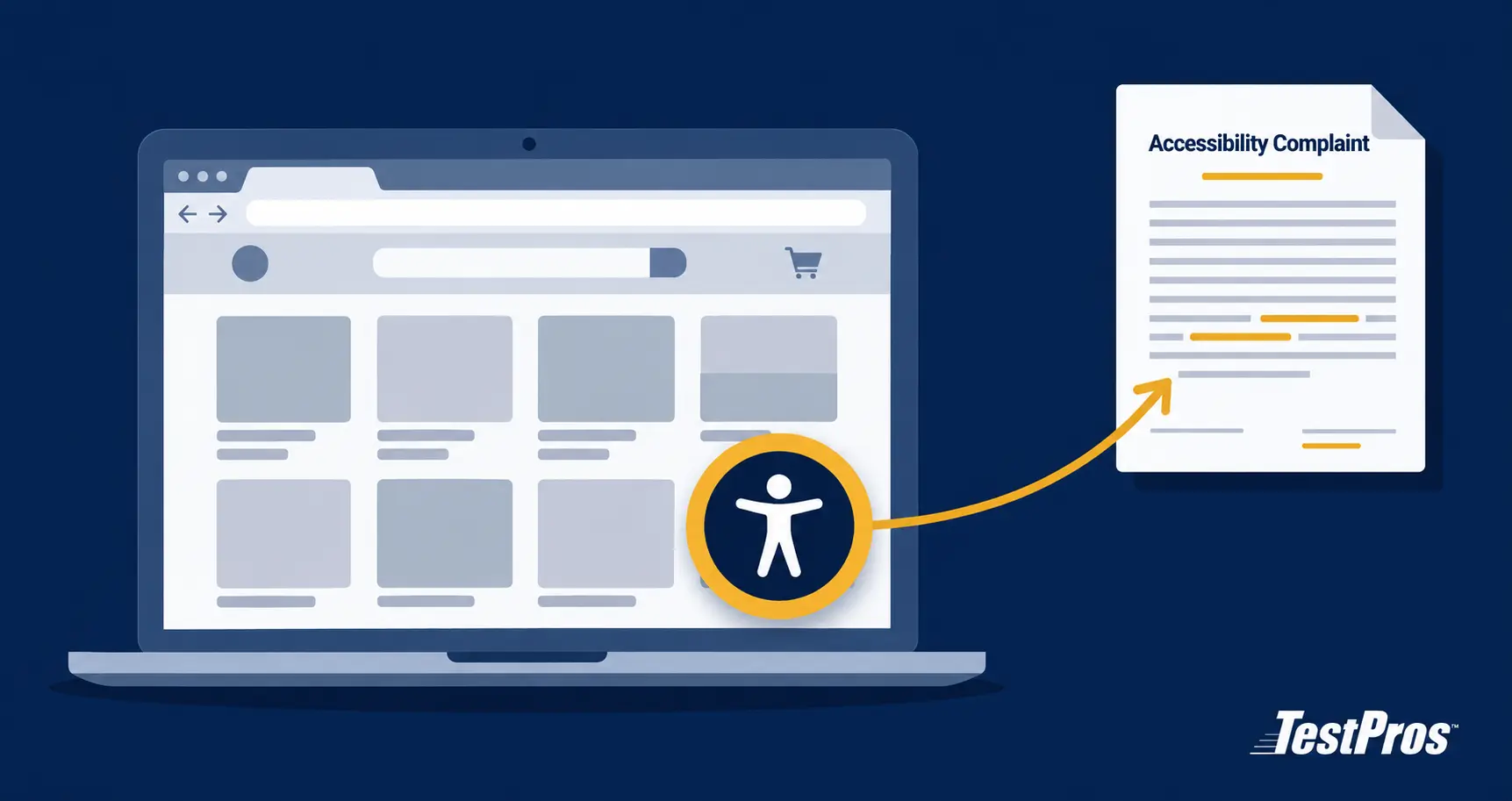
Thousands of companies installed an accessibility widget, watched it drop a little icon in the corner of their site, and decided their legal risk was handled. It was not. Web accessibility lawsuits are on pace for a record year in 2026, and a growing share of them name sites that were running exactly that kind of widget.
TestPros is an independent digital accessibility assessment firm, and in our testing the pattern is consistent: the tools companies install to avoid these suits are often the same ones that turn up as evidence in them. Here is what the 2026 numbers actually say, and what a court and a screen-reader user would look for on your site.
How many web accessibility lawsuits are there in 2026?
Web accessibility lawsuits are on track for a record 2026. UsableNet, which tracks digital accessibility litigation across federal and state courts, projects filings will top 6,000 this year, roughly 20% above 2025 and the most it has recorded. In federal court alone, plaintiffs filed 3,117 website accessibility cases in 2025, up 27% in a year and now 36% of all ADA Title III filings.
Those website cases sit inside a broader surge. Total ADA Title III federal filings reached 5,006 in the first half of 2026, the highest first half since 2021, and they concentrate in a few states: California led with 2,426, followed by Florida at 709 and Illinois at 505. Those Title III totals include physical-access cases, but website and mobile-app claims are a large and growing slice, and New York state courts, which the federal count does not include, add thousands more on top.
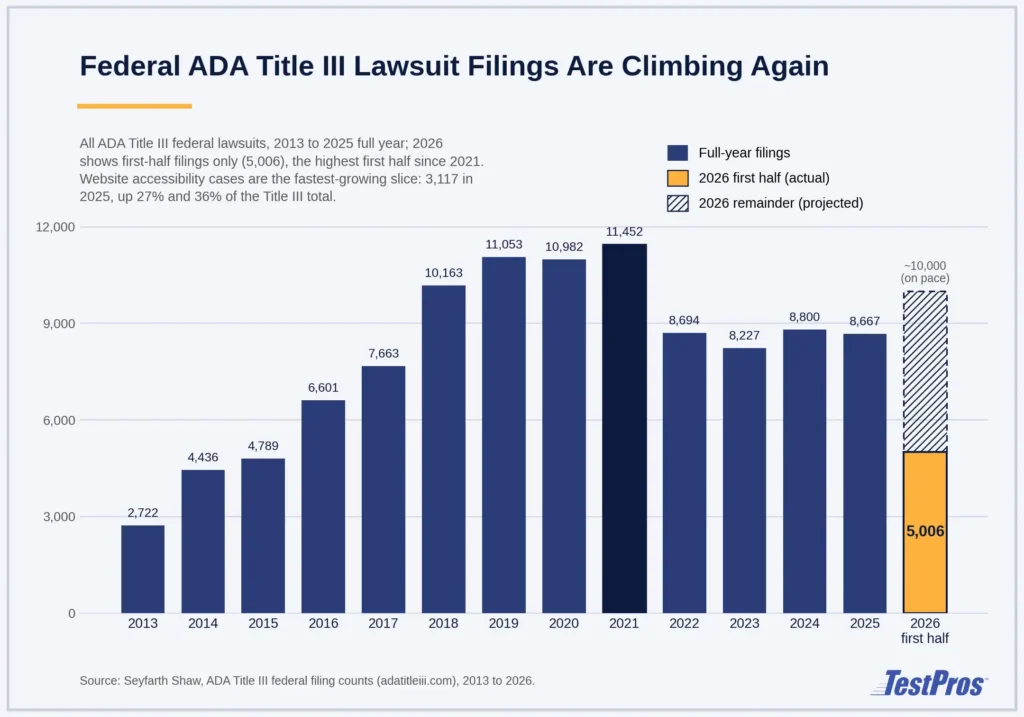
The headline number is a count of cases filed, not a measure of how many sites have real barriers. That gap is the story of the year.
Why do the lawsuit numbers keep climbing?
The numbers climb because filing is cheap, the barriers are easy to document, and more of commerce runs through a website every year. A plaintiff’s firm can identify a non-conforming site, send a demand letter, and settle without ever seeing the inside of a courtroom. When the same template works on hundreds of sites, volume follows.
The dollar exposure behind those filings is real. In a California class action, the apparel retailer Fashion Nova agreed to a settlement valued at $5.15 million over a website a blind shopper could not use with a screen reader, after five years of litigation. The case did not even end cleanly. In February 2026 the U.S. Department of Justice opposed the deal, arguing it paid the plaintiffs’ attorneys well while the accessibility fixes it required were generic language with no way to enforce them. A settlement that does not actually make the site usable is not the finish line, and it is no substitute for building the site right.
The overlay boom made it worse. As companies rushed to install widgets after seeing a competitor get a letter, many stopped there, believing the box was checked. A site that looks handled but still traps a keyboard user or hides a form label from a screen reader is exactly the kind of target a serial filer looks for. Our explainer on how Title III applies to your website walks through which businesses are covered and why “we have a widget” is not the same as “we are accessible.”
Every year that more buying, banking, and booking moves online, the pool of sites a plaintiff can test grows, and so does the pool that fails.
Do accessibility overlays protect you, or put you at risk?
Overlays do not protect you, and regulators have said so on the record. An accessibility overlay is a third-party script that claims to detect and auto-fix accessibility problems on your site. Courts have allowed cases to proceed against sites running them, and in April 2025 the Federal Trade Commission finalized a $1 million order against overlay vendor accessiBe for deceptive claims that its product could make a website WCAG and ADA compliant.
That order matters for a buyer because it targets the exact promise the overlay was sold on. If the tool cannot deliver compliance, then paying for it does not lower your legal exposure, and the widget in your footer can be named as part of the complaint rather than a shield against it. The icon signals to a plaintiff that you knew accessibility was an obligation and reached for the cheapest option.
An overlay is a remediation product making a promise it cannot keep. It is a different thing from the detection tools discussed next, and it fails for a stronger reason.
What do automated scanners miss, and why do plaintiffs cite it?
Automated scanners catch many real problems, but they cannot tell whether a person using a screen reader can actually complete a task, and that is what plaintiffs cite. A scanner flags a missing image description; it cannot judge whether the description that is there is meaningful. It reads a contrast ratio; it cannot follow a checkout flow by keyboard and notice that focus vanishes at the payment step.
The detection tools do real work. WebAIM’s annual scan of the top one million home pages detected WCAG failures on roughly 95% of them, so the underlying problem is genuinely widespread. Detection is not where sites fall short in a lawsuit. Judgment is, and the difference between automated and manual accessibility testing is exactly the set of barriers a human tester finds and a scan cannot.
| Accessibility check | Automated scanner | Manual WCAG test |
|---|---|---|
| Image descriptions | Detects when alt text is missing | Judges whether the description is accurate and meaningful |
| Color contrast | Detects reliably against the ratio | Confirms contrast across real hover, focus, and error states |
| Form labels | Detects when a label is missing | Judges whether the label makes sense in context |
| Keyboard navigation and focus order | Limited, cannot operate the flow | Every element and flow operated by hand, checking for traps |
| Screen-reader usability (NVDA, JAWS, VoiceOver) | Cannot assess | Tested with the real assistive technology, as a user would |
| Whether an error message is understandable | Cannot assess | Judged by a certified human tester |
This is not a niche opinion. It is the position of the body that writes the accessibility standard itself.
No tool alone can determine if a site meets accessibility standards. Knowledgeable human evaluation is required to determine if a site is accessible.
A plaintiff’s expert is a knowledgeable human evaluator. If the only thing standing between your site and a complaint is a script that a human evaluator can defeat in minutes, you do not have a defense.
What actually holds up in a lawsuit: independent, manual WCAG testing
What holds up is a site that has been tested by hand against the standard, by certified people, with a record that shows the work. The benchmark courts and demand letters point to is WCAG 2.1 and 2.2 AA conformance, and conformance is a human judgment about whether real people can use the site, not a score a scanner prints.
There is a reason that benchmark comes from case law rather than a rulebook. For private businesses under Title III, the Department of Justice has never issued a technical web accessibility regulation; its 2024 web accessibility rule applies only to state and local governments under Title II. There is no federal checklist for a business to wait for, and in its absence courts and settlements have consistently pointed to WCAG. That is what makes private litigation the real enforcement mechanism, and WCAG 2.1 and 2.2 AA the standard your site is effectively measured against whether or not you have chosen to meet it.
TestPros is tool-agnostic. We specialize in manual testing by certified testers, holding IAAP WAS and DHS Trusted Tester credentials, using real assistive technology: NVDA, JAWS, and VoiceOver, keyboard-only navigation, and screen magnification, across desktop and mobile. We use an automated scanner as the baseline first step because it is efficient for the issues it catches, and because we sell no proprietary tool, that choice is driven only by what produces the most accurate assessment. Independent tool selection makes the resulting report more defensible if a claim ever lands.
The output is not a certificate. It is a findings report that documents what was tested, what failed, and how to fix it, the paper trail that shows a court you took the obligation seriously before anyone asked.
What should you do if you got a demand letter?
Move quickly, and do not treat the widget in your footer as your answer. A demand letter is a claim that your site has barriers a real user hit, and the response that carries weight is evidence that you tested for those barriers and fixed them.
Get the site tested by hand. Commission an independent ADA website audit that puts a certified tester on your actual user flows with real assistive technology. That is what surfaces the failures a plaintiff’s expert would cite and tells you where you truly stand.
Fix the real barriers and keep the record. Prioritize the issues that block a user from completing a task, remediate them, and retain the before-and-after documentation. A dated findings report and a remediation record are the difference between “we care” and “we can show it.”
Stop relying on the overlay’s badge. Whatever compliance claim the widget makes, it is the claim a regulator has already penalized a vendor for making. It will not carry your defense, and continuing to lean on it is the posture that drew the letter.
Filings are not slowing down. With web accessibility lawsuits on pace for a record 2026 and no year-end lull in the pattern, the site that gets tested this quarter is the one that is ready before the next letter goes out.
Web accessibility lawsuits are on pace for a record 2026
Get an independent, manual WCAG audit before a demand letter arrives.
Filings are climbing and the pattern does not pause at year-end. TestPros tests your site the way a court and a screen-reader user would, using real assistive technology, then documents exactly what to fix. No software or overlay to sell, so the findings stand on their own.
Request a website accessibility auditFrequently asked questions
Can you sue a business for ADA website violations?
Yes. Under ADA Title III, a person with a disability can sue a business whose website is a place of public accommodation if barriers prevent them from using it. Most cases settle before trial, which is part of why filing volume is so high. There is no federal filing fee barrier for a plaintiff, and demand letters often resolve for a payment plus a commitment to remediate, so a business rarely gets to argue the merits before it is deciding whether to settle.
Are web accessibility lawsuits increasing in 2026?
Yes. UsableNet, which tracks digital accessibility litigation across federal and state courts, projects web accessibility lawsuits will top 6,000 in 2026, a record and about 20% above 2025. In federal court, website accessibility cases reached 3,117 in 2025 alone, up 27% year over year and now 36% of all ADA Title III filings. Total ADA Title III federal filings, which also include physical-access cases, hit 5,006 in the first half of 2026, the highest first half since 2021, and New York state courts add thousands more that the federal count does not include.
Do accessibility overlays protect you from lawsuits?
No. Accessibility overlays are third-party scripts that claim to auto-fix accessibility, and they are not treated as a compliance path. Courts have let cases proceed against sites running them, and in April 2025 the FTC finalized a $1 million order against overlay vendor accessiBe for deceptive claims that its tool could make a site ADA compliant. An overlay can appear as part of a complaint rather than a defense against one, because it signals the barrier was never actually fixed.
How do you defend a website against an accessibility lawsuit?
You defend it with evidence that the site was tested and remediated before the claim. The standard that courts and demand letters reference is WCAG 2.1 and 2.2 AA, and conformance is confirmed by manual testing with real assistive technology, not by an automated score. A dated findings report showing what was tested, what failed, and what was fixed is the documentation that demonstrates good-faith compliance. In our assessment work, that record is what changes the conversation from whether you tried to whether you can prove it.
Primary source: Seyfarth Shaw, 2026 Mid-Year Report on ADA Title III federal lawsuit filings, Sep 9, 2026. Backs the 5,006 first-half total, the highest-since-2021 framing, the 9% year-over-year rise, the California, Florida, and Illinois state figures, and the on-pace-to-top-10,000 projection.
Additional sources:
- Seyfarth Shaw, Federal Court Website Accessibility Lawsuit Filings 2025, Mar 2026. Backs the 3,117 website accessibility filings in 2025, the 27% year-over-year rise, and the 36% share of all Title III filings.
- UsableNet, 2026 Mid-Year Report on digital accessibility litigation (tracking federal and state court filings), 2026. Backs the projection that web accessibility lawsuits will top 6,000 in 2026, a record and roughly 20% above 2025.
- Federal Register, DOJ final rule on web accessibility for state and local governments (Title II), Apr 2024. Backs the point that the only federal web accessibility rule applies to Title II governments, not to private businesses under Title III.
- U.S. Department of Justice, statement opposing the Fashion Nova class settlement, Feb 2026. Backs the $5.15 million settlement figure and the DOJ objection that its injunctive relief was generic and unenforceable.
- Federal Trade Commission, final order on accessiBe, Apr 2025. Backs the $1 million penalty for deceptive overlay compliance claims.
- W3C Web Accessibility Initiative, Evaluating Web Accessibility. Backs the point that human evaluation is required and no tool alone can determine conformance.
- WebAIM Million. Backs the figure that detectable WCAG failures appear on roughly 95% of top home pages.